Introduction
In modern marketing and sales activities, "Lead Scoring"—the quantitative evaluation of a prospect's (lead's) level of interest and purchase intent—is a critically important method for effectively deploying personalized marketing strategies. This approach, primarily implemented using Marketing Automation (MA) tools, aims to efficiently identify leads with a high probability of closing by assigning points based on the lead's attribute information and behavior history.
By introducing lead scoring, it becomes possible to provide optimal proposals according to each score level, concentrate limited management resources on customer segments with a high likelihood of contract conclusion, and significantly improve the efficiency of overall sales activities. This article provides a detailed explanation ranging from the basic mechanism of lead scoring to specific design procedures, operational points of caution, and strategies for improving accuracy using MA tools. Through this, we provide practical insights useful for the introduction or improvement of lead scoring in your business.
"Scoring" in the fields of marketing and sales, also referred to as "Lead Scoring," refers to the process of evaluating purchase intent for held prospects (leads) based on their attribute information and behavior history, and quantifying their probability. For example, points are set for patterns such as the industry the customer belongs to, company size, job title, or actions like the number of website visits, duration of stay, and resource downloads, and a total score is calculated.
This method is particularly frequently used in Marketing Automation (MA) systems within B2B marketing. Through scoring, it realizes a meticulous approach tailored to the prospect's degree of interest and understanding of the product or service.

Usage Scenarios and Objectives
The management and nurturing of prospects consist of a series of flows where acquired lead information is appropriately classified and converted into high-quality leads through a nurturing process; lead scoring is integrated into this flow.
Scoring is closely related to Lead Qualification (the selection and narrowing down of prospects). Data on prospects immediately after acquisition usually only contains basic information such as "personal information" and "inflow source (e.g., exhibitions, online advertising, etc.)." Subsequently, in the lead nurturing phase, as communication is sought with the prospect through various content, scores are added from each and every action.
Through this scoring, it becomes possible to possess objective data regarding the "high degree of interest in the product," and this numerical value becomes an important indicator for lead qualification.
The Role in Lead Qualification
Lead Qualification refers to the process of identifying high-quality leads from among acquired prospects who are likely to lead to a contract for one's own products or services. Lead scoring provides extremely objective and specific evaluation criteria in this selection process. For example, actions such as a high frequency of access to the website, downloading a specific white paper, or viewing the pricing page multiple times strongly suggest that the prospect's purchase intent is high. By assigning appropriate scores to these actions, it becomes possible to narrow down leads with high probability based on clear numerical values, rather than subjective judgments like "they seem somewhat interested."
Through this mechanism, sales representatives can focus on "hot leads" that should be contacted preferentially from a vast lead list, reducing waste in sales activities and dramatically improving efficiency. Lead scoring serves as an indispensable indicator not only for the "current" interest level of a prospect but also for predicting the possibility of future contract conclusion.
Optimization of Sales Activities
Lead scoring becomes the foundation for significantly improving the efficiency of sales activities. By clearly quantifying the high or low purchase intent of prospective customers, it becomes possible to plan the most effective approach tailored to each lead. For leads with high scores, the sales team can concentrate on direct actions, such as actively linking them to business negotiations and aiming for a contract through specific proposals.
On the other hand, for leads with low scores, it may be judged that results are unlikely even if sales intervene immediately. In such cases, the goal is strategic relationship building from a long-term perspective, such as nurturing the customer's interest or needs through nurturing programs or considering guiding them to another product suited to the customer's situation. In this way, since personalized sales activities can be deployed according to the current situation and purchasing stage of individual prospective customers without wasting precious resources, it also contributes to enhancing the quality of the customer experience.
The Significance of Lead Scoring
With the spread of Marketing Automation (MA), which deploys "One-to-One" measures by tagging leads according to their characteristics and classifying them into individual segments, the importance of lead scoring has risen dramatically. In modern digital marketing and sales strategies, lead scoring plays an indispensable role in the following points:
Strengthening Alignment Between Sales and Marketing

The introduction of lead scoring builds the foundation for the sales department and marketing department to evaluate leads using a common standard. Without a common evaluation axis, differences in perception and conflict between departments tend to arise, such as "the leads provided by marketing are of low quality" or "sales is always complaining about leads." However, by using lead scoring, the probability of a lead can be clearly shown based on objective scores, making it possible to prevent such friction.
As a result, the cooperative framework between sales and marketing is strengthened, and more unified activities can be deployed toward the common goal of closing contracts. Because scoring clarifies the degree of maturity of leads created by marketing and which phase of leads sales should focus on, the roles and responsibilities of each department become clear, and a seamless coordination system is constructed.
Strategic Utilization of Existing Lists
Lead scoring not only identifies leads with high purchase intent but also has the effect of highlighting lead segments with low current interest. By being able to visualize these low-score leads, strategic approaches suited to their state become possible.
For example, for leads who participated in a seminar in the past but have not led to specific purchasing behavior thereafter, continuing the same approach repeatedly may have a low possibility of leading to results. However, by establishing hypotheses for why they do not reach purchasing behavior, such as "the value of the product has not been sufficiently conveyed" or "it does not fit the customer's current challenges," and presenting appropriate information or alternative solutions, there is a full possibility of leading to a future contract. From the perspective of maximizing acquired business opportunities, lead scoring is an extremely important initiative. Scoring can be called an indispensable process for discovering leads with potential value from the entire list held and utilizing them to the maximum.

AI Scoring as the Mainstream in the US, Now Performing Predictions
The evolution of Marketing Automation (MA) technology is accelerating the realization of advanced automatic scoring. Based on communication with prospective customers through automatically delivered content and their reactions, automatic scoring by AI and machine learning has been introduced, and predictive modeling from large-scale data has also begun to be utilized.
AI scoring automatically learns complex behavioral patterns and correlations that tend to be overlooked by traditional rule-based methods, enabling higher-precision predictions. This capability contributes to smoothing marketing and sales activities by predicting the future behavior of prospective customers, such as conversions (closing). Currently, the introduction of lead scoring is indispensable for deploying personalized One-to-One measures.

The Mechanism of Lead Scoring and Three Scoring Criteria
In lead scoring, the score assigned to individual prospective customers is determined primarily from the following three perspectives. These perspectives are extremely important for evaluating the customer's purchase intent from multiple angles and enabling higher-precision lead selection. Competitor articles similarly cite three elements: the customer's external information (attributes), internal information (interest), and behavioral information (activity level), and by judging these comprehensively, it becomes possible to measure the probability of a lead minutely.
1) Customer Attributes (Manual Scoring) - External Information
This scoring criterion is evaluated based on external information that is relatively stable and easy to obtain, such as the lead's company size, industry, job title, and location. For example, weighting is set in advance according to the position of the person in charge, the industry/scale of the customer company, and the utilization status of competing products—such as +5 points if the customer is an officer with decision-making authority, or +5 points if they already use a competitor's product. This is because attribute information, such as the customer having decision-making authority or a high level of understanding of the product/service, greatly affects the possibility of concluding a deal.
In articles from other companies, specific examples of point additions are shown, such as +20 points if the lead's industry matches the company's target segment, and an additional +10 points if they are an officer with approval authority. External information has the great advantage that it is often relatively easy to obtain at the time of lead acquisition, allowing a certain degree of scoring to be implemented at an early stage. The higher the degree of fit with the company's ideal target corporate image, the higher the score assigned, and as a result, the priority of the sales approach improves.
2) Customer Interest (Automatic Scoring) - Internal Information
This criterion evaluates the intrinsic interest shown by prospective customers through contact with content and the specific challenges they face. Specifically, points are added for actions such as participating in exhibitions or seminars, viewing webinars, using free trials, or viewing comparison tables, price lists, and service support pages. From these actions, it becomes possible to grasp the degree of interest the prospective customer has in the company's products or services and perform appropriate follow-up tailored to their consideration stage.
For example, one competitor article cites a specific example where +10 points are given if a user downloads a white paper regarding an internal information centralization solution after reading content introducing challenges due to the dispersion of internal information and their solutions. This indicates that scoring is performed when the lead's needs and the product match. Regarding internal information, a certain degree of inference is possible from the lead's actions, but to obtain deeper information, such as dissatisfaction points with services currently in use or detailed challenges faced, it is necessary to build a relationship of trust through communication, and the difficulty of obtaining information tends to be high.
3) Customer Activity Level (Automatic Scoring) - Behavioral Information
This criterion evaluates the frequency of actions taken by the prospective customer and the time elapsed since those actions—in other words, the "freshness" of the information. The actions evaluated in the aforementioned (2) also differ in the heightening of the customer's interest depending on whether they are recent or if time has passed. A customer who was active frequently several months ago might have already introduced a competitor's product or service, or they might have interrupted consideration for some reason.
Conversely, for a customer who has frequently visited the website in the last few weeks, the possibility of concluding a deal can be dramatically increased by approaching them as quickly as possible. For example, points are added for the activity level based on the shortness of time elapsed from the action or high frequency of actions, such as access history within the last X days to the website or whether there were X or more accesses in the last week. Competitor articles also point out that "even for leads with the same score, the probability of closing differs depending on whether or not they have taken action recently," and the freshness of behavioral information is an extremely important factor in measuring a lead's purchase intent.
In this way, it is vital to assign appropriate scores according to the customer's situation from these three different perspectives and link them to the expected next action based on those scores.
Benefits of Lead Scoring
The introduction and effective operation of lead scoring bring a wide range of benefits to a company. This is not merely limited to the quantification of prospective customers but is a strategic approach aimed at improving the efficiency and strengthening the productivity of the entire organization. Specific benefits are as follows:
Realization of Efficient Sales Activities

Lead scoring clearly visualizes the presence or absence and degree of purchase intent. This allows the sales team to approach leads judged to have high purchase intent more actively and preferentially, making it possible to focus on sales activities likely to lead to results while reducing unnecessary man-hours. For example, for high-score leads, they concentrate on actions directly linked to closing, such as providing specific product demonstrations or opportunities for individual consultation.
On the other hand, for leads with low scores, instead of sales intervening immediately, the marketing department provides information to increase interest through nurturing measures. In this way, the most appropriate approach according to the consideration status or degree of interest of the prospective customer becomes possible, which consequently contributes to improving customer satisfaction. CRM/SFA tools like Salesforce Sales Cloud powerfully support such sales efficiency through the centralized management of customer and project information, smooth information sharing, and clear visualization of data.
Functional Optimization of Sales and Marketing
The introduction of lead scoring clarifies the division of roles between the sales team and the marketing team, creating an environment where each department can focus maximally on activities in which they specialize. Specifically, the marketing department aims to nurture prospective customers and improve their scores for those whose engagement scores are still low, through the provision of information (content delivery) matching their interests and problems, planning of webinars and events, and continuous nurturing activities via email.
As a result, prospective customers whose purchase intent has increased beyond a certain standard are handed over to the sales department as "hot leads." This allows the sales team to deploy sales activities by narrowing down to leads with high purchasing probability, contributing to the efficiency of business negotiations and significant improvement in the closing rate. In this way, by establishing a system where sales and marketing can approach each lead without overlap and at the most effective timing, smooth coordination between departments is promoted, and the efficiency and productivity of the entire organization improve dramatically.

How to Proceed with Scoring Implementation and Important Points
In this section, we will delve into the specific introduction procedure of lead scoring using MA (Marketing Automation) tools and the key elements for maximizing its effect. Lead scoring is not completed once it is integrated into the system; it is extremely important to continuously evaluate and adjust it according to changes in the market and customers.
1. Formulation of Scoring Criteria
The first thing to handle is to clarify behavior patterns in the process until the customer reaches the final purchase. As already mentioned, when constructing lead scoring, it is vital to proceed with consideration from three major aspects. Among these, "static attributes (demographic information, etc.)" can be collected and analyzed relatively easily, but when designing scoring from aspects such as "behavior (website browsing history, etc.)" and "engagement (email open rates, etc.)," it is required to depict the entire consideration process—what steps your customers actually take to reach a contract—as a hypothesis in as much detail as possible. At this stage of hypothesis construction, it is extremely important to incorporate not only the expertise of the marketing department but also the insights of the sales department, which directly dialogues with customers and proceeds with negotiations daily.
Perspectives of Scoring Provided by the Sales Team
What kind of needs or challenges do customers have, what consideration routes do they follow for those challenges, and what final decisions do they make? Regarding these elements, sales representatives have deep insights necessary for the design of lead scoring. For example, the specificity of the business challenges the customer faces, the urgency of solving those challenges, the key figures involved in the decision-making process, and the status of budget security are extremely important information sources that directly affect the closing.
These data become indispensable elements when setting scoring criteria based on the prospect's interest level and behavior history. When constructing a scoring model, elements such as the quality and urgency of business challenges obtained from dialogues between sales representatives and prospective customers should also be included as important considerations for predicting subsequent prospect behavior and reflecting it in the score.
Evaluation Axis from the Marketing Side
The marketing department likely consolidates a wide range of customer data, such as behavior history on the website, downloaded materials, email open rates, participation status in seminars or webinars, and even inquiry history to the call center. These data serve as valuable clues to highlight specific interest levels and potential needs held by prospective customers, in forms such as repeatedly viewing specific service pages, deeply reading blog articles on specific themes, or watching video content to the end.
This information is obtained through interactions between the company and the customer and is extremely important for inferring the current degree of consideration of each prospective customer. Especially in the case of prospective customers whom sales representatives have not yet contacted, this information serves as a compass for judging their depth of consideration or rising purchase intent, predicting the possibility of reaching a contract, and then deploying individually optimized approaches.
Points of Caution when Setting Score Elements
In the introduction of lead scoring, setting a large number of complex evaluation items from the beginning is often inefficient and tends to become an operational barrier. It is wise to start by identifying existing "excellent leads who reached a contract with high probability" based on experience accumulated in previous sales and marketing activities, and analyzing in detail what attributes they had and what behavioral patterns they showed.
Based on these analysis results, evaluation items are devised by focusing on behaviors and attributes that are actually easy to link to a contract. Starting from a simple item setting and taking an approach to detail it in stages through actual operation is the key to constructing an effective scoring model while suppressing unnecessary costs. The vital point is to always continue verifying how much the set evaluation items contribute to actual business results from an objective perspective.
2. Utilization of Scoring
After score setting is completed, it is finally time to transition to the actual operation phase. First, based on existing customer information, start with simple score settings, such as assigning specific points to static attribute information like industry and company size, and individual points to behavior history like viewing major pages of the company site (product/service details, pricing plans, etc.). Thereafter, it is important to review scoring criteria as appropriate while repeating operation and steadily improve its accuracy.
As a result of scoring, when the total score exceeds a specific standard value or when all the multiple evaluation axes mentioned above meet the standards, clearly define the conditions for judging them as high-probability prospective customers (hot leads). Prospective customers who meet these conditions are promptly linked to the sales department. Since leads who are linked are inferred to already have sufficient purchase intent, sales representatives are expected to quickly set appointments and move business negotiations forward.
Test Operation and Improvement Cycle
Once score items are formulated, first try applying scoring experimentally to existing leads who are already active. Through this test operation, you can confirm to what extent the set score items match actual lead behavior and final contract results. For example, gaps between assumptions and reality may be found, such as "we gave high points to this action, but in reality, it is difficult to link to a contract."
Based on information obtained in the test operation with existing leads, improve accuracy by performing adjustments of score items or changes in weighting. Next, apply scoring to new leads as well and collect new feedback. Data from new leads may bring new challenges or hints for improvement that were not visible with existing leads. If problem points become clear, the marketing department and sales department coordinate again to consider solutions. By repeating this cycle of testing and improvement, it becomes possible to establish a more practical and effective lead scoring model.
3. Correction of Score Values and PDCA
In lead scoring, purchase intent of potential customers is basically judged based on scores, and they are linked to the sales department at the appropriate timing. However, with simple score settings as they are, there exist risks—such as cases where they do not reach actual contracts even if the score is high, or conversely, leads who were judged to have low scores and thought not to be proceeding with consideration end up flowing to another company. If such a situation becomes clear, it is essential to quickly analyze the cause and continuously perform reviews and optimization of score settings on the PDCA cycle.
Regularly verify the relationship between scoring evaluation criteria and actual conversion rates, and review score allocations or the evaluation items themselves as necessary. For example, despite high scores being set for a specific action, if the closing rate of leads who took that action is low, adjustments are necessary, such as decreasing the score for that behavior or increasing the score for another effective behavior. To constantly improve the accuracy of lead scoring while running the PDCA cycle based on data, it is good to construct mechanisms such as providing regular review periods.
Points of Caution for Improving Scoring Accuracy
To utilize lead scoring to the maximum and improve its accuracy, it is required to understand and practice several important points. By holding down these points, scoring will function as a powerful tool that truly contributes to business growth without being influenced by individual judgment.
Unifying Scoring Criteria
If the criteria for lead scoring are unclear, variations in evaluation occur, resulting in individualization. For example, with an item like "viewing content for a long time" alone, since the specific definition of "long time" differs from person to person, the objectivity of scoring is impaired. To avoid this, it is important to clearly define criteria using specific numerical values, such as "people who viewed for X minutes or more."
Also, since the target customer segment and the process until purchase differ depending on the product or service, the optimal scoring setting also changes. Therefore, evaluation criteria for scoring should be formulated by relevant departments such as marketing, sales, and product development conducting cross-departmental discussions and gathering their respective expertise. Clear and unified criteria are mandatory for ensuring the fairness and reliability of lead scoring.
Furthermore, regarding score allocations, we do not recommend carving out detailed and strict points from the initial stage. The reason is that in the initial lead scoring, many points are still unknown, and trial and error are necessary. If subdivided too much, there will be less room for subsequent adjustment, and cases are often seen where the points themselves become hollow and are no longer utilized.
Judging Comprehensively from Multiple Actions
When implementing lead scoring, it is vital not to judge the probability of a lead based on a single action or attribute alone, but to evaluate multidimensionally from multiple information sources. For example, even if a high score is assigned just by viewing a specific page of the website once, if that is merely temporary interest, it may be difficult to link to an actual conversion.
Especially in B2B marketing, the period from purchase consideration to decision-making is long, and it is common for customers to refer to and compare diverse information. Therefore, by combining not only the latest action but also past behavior history, diversity of viewed content, email engagement, and even profile data, it becomes possible to grasp purchase intent with higher precision. For example, it is important to read trends from a series of lead behavior histories, such as the combination of the type of white paper downloaded previously and the price page viewed recently.
Avoiding Excessive Scoring of Actions
Lead scoring is an extremely effective strategy, but it is not necessary to forcibly quantify every action a lead takes. Particularly, for actions where it can be clearly judged that the prospective customer is already in the purchase consideration stage—for example, a "request for a quote"—the possibility of reaching a contract increases dramatically if a sales representative timely and directly presents a quote and follows up on specific budgets or requests, rather than considering the priority of the approach through a scoring system.
Instead of scoring all actions, it is vital to perform evaluations from the perspective of how important that action is for one's own marketing activities or sales activities. Scoring functions effectively when prioritizing leads in the nurturing stage before sales approaches directly or when judging conditions for handover to the sales department. It is wise to flexibly decide which actions to apply scoring to and for which actions an immediate direct approach should be performed according to one's own sales process or lead characteristics.
Considering Automatic Score Decay Functions
The purchase intent and interest level of leads possess the nature of fluctuating with the passage of time. Even for a lead who recorded a high behavioral score several months ago, if no subsequent activity is seen, it is possible they have already introduced a competitor's product or have interrupted the consideration itself. In this way, to accurately reflect the decline in the "freshness of interest" of a lead accompanying the passage of time, it is important to incorporate the function of "Score Decay."
Score decay is a mechanism where scores added by a lead's engagement or specific events automatically decrease with the passage of time. For example, even if 10 points are added for a certain form submission, if set to decay by 50% every month, the importance of that action naturally decreases with time to 5 points after one month and 2.5 points after two months. Many MA tools are equipped with a function to set this decay interval (e.g., every month, every 3 months, every 6 months, every 12 months). By introducing score decay, higher-precision prioritization of leads reflecting the latest interest level becomes possible, and the risk of sales representatives overlooking leads who should be approached most preferentially can be minimized.
Application Examples of Scoring
In lead scoring, it is important to conduct consideration from a multidimensional perspective—not only continuous PDCA cycles to improve the precision of score settings but also whether there are information sources available for utilization other than items already set.
An Example of Scoring Operation
Here, we introduce a characteristic case experienced by our team. This concerns the "scoring of interest levels." In the case of a certain automobile sales company, the mechanism allowed customers to make inquiries about automobiles they were interested in through the website. We aimed for further improvement in the business negotiation rate by recommending highly relevant vehicles, rather than merely inventory information on the inquired vehicle.
Generally, scoring would often be performed based on information on the inquired vehicle. For example, elements such as vehicle category, body color, price range, and whether it is a new or used car. However, with only this information, potential interests or needs of the customer may be overlooked. Therefore, we introduced a method to obtain browsing history data of the customer on the website and perform scoring using AI. Through this, we succeeded in raising the precision of the score to a level where vehicles matching the customer's potential interest could be recommended with higher scalability.
As a result of this approach, the click-through rate of related vehicles, which was 3% as the market average, improved to an astonishing 20%. In this way, scoring can be applied not only to merely evaluate and select leads but also as "Value-Creation Scoring" to draw out hidden needs of customers and lead to effective approaches.
Modern Evolution of MA Tool Scoring Functions
Modern Marketing Automation (MA) platforms exceed mere point calculation for leads and provide more sophisticated and flexible scoring functions, powerfully driving the efficiency of marketing and sales activities as well as personalization. Particularly in industry-leading MA tools like HubSpot, the scoring approach has evolved remarkably, allowing leads to be evaluated from multidimensional perspectives. Also, Account Engagement (formerly Pardot) is attracting attention for its high-precision scoring functions utilizing AI.
Introduction of New Lead Scoring Functions in HubSpot
Although a lead scoring mechanism existed in HubSpot from before, a completely new "Lead Scoring" function was introduced. This stands apart from previous scoring utilizing properties and is established as an independent dedicated function.
Dedicated Functionality and Multidimensional Scoring Evaluation Axes
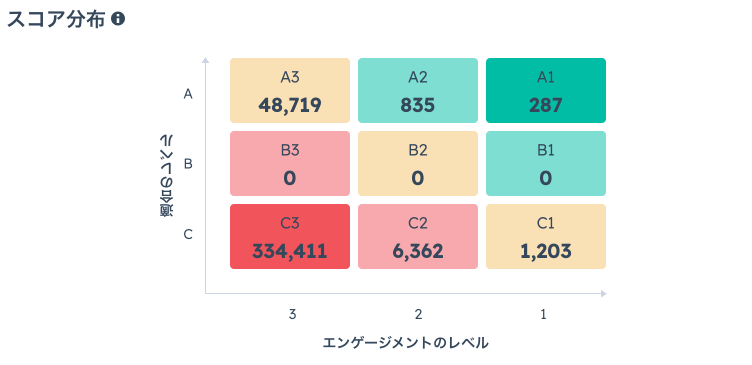
While traditional scoring was set using specific properties, the new function is provided as an independent dedicated menu, and the process of setting and management has become dramatically more intuitive. The scoring approach has also evolved greatly, divided into two main types. Previously, various elements were integrated in one property, but in the new function, two types were introduced: the "Engagement Score" based on the lead's behavior history and the "Fit Score" based on attribute information such as industry and number of employees. This has made more detailed and multidimensional evaluation possible from both sides: "what" the lead is doing and "who" they are. Initially, it was necessary to manage them separately, but through the update in November 2024, the creation of combined scores has been realized, allowing for integrated comprehensive evaluation of engagement scores and fit scores seamlessly.
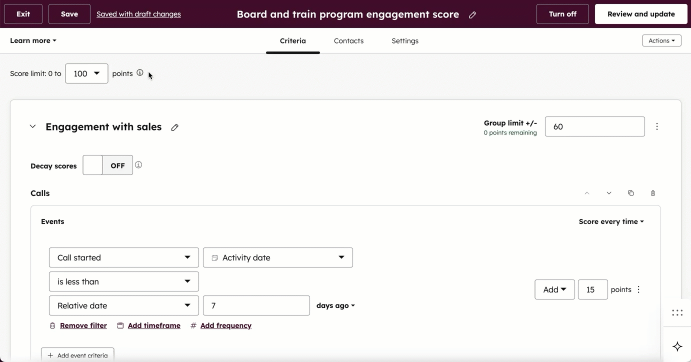
Reference: Understand the HubSpot Lead Scoring Tool. https://knowledge.hubspot.com/scoring/understand-the-lead-scoring-tool
Improved Management and Control of Score Values
In previous functions, since an upper limit for the score was not set, cases were seen where values became extremely high or unrealistic. However, in the new function, it has become possible to set an upper limit for points, making management of lead scores much easier. This upper limit setting can be applied not only to the overall score but also to specific group units. For example, while setting the overall maximum value to 100 points, items related to web access can be limited to a maximum of 80 points, allowing scores to be organized and adjusted more flexibly and strategically according to the importance of each score item group.
Dramatic Improvement in Automation and Accuracy
The new HubSpot lead scoring function has achieved great evolution in both automation and evaluation precision. More meticulous dynamic scoring has become possible, such as "adding points every time a specific action is repeated," which was difficult in the old version. For example, settings where a score is added every time a specific page is visited multiple times, and of course, one-time point addition settings can be performed flexibly.
Furthermore, a unique function of "score decay," which automatically decreases the score with the passage of time, was also introduced. This allows for reflecting that the importance of past actions gradually fades. For example, even if 10 points are obtained by a form submission, if set to decay by 50% every month, that interest level naturally decreases with time. Since score decay also applies to past data, the current activity level of a lead can always be grasped accurately without being too influenced by old history. Additionally, in this new function, actions prior to performing the setting are also subjects of evaluation; therefore, when score rules are applied, it also possesses the convenient aspect of automatically presenting calculation results based on all actions retrospectively.
Intuitive UI and Powerful Integration
The new scoring function has a refined User Interface (UI), and operability has improved dramatically with visual clarity. In addition, by setting customizable thresholds, a function to automatically classify leads with three stages of labels ("High," "Medium," "Low") has been installed. The old function did not have such a classification function, but this makes it possible to grasp lead prioritization at a glance.
Since this label data is saved as a property, integration with other HubSpot tools is extremely smooth, such as automating workflows using this value as a trigger. On the right sidebar of the contact detail screen, a dedicated card for the score is displayed, and from "View score history" within it, it is possible to confirm the history of score fluctuations to date in detail.
Expansion of Flexibility in Operation
The new scoring function has also significantly strengthened flexibility in its operational aspect. A function to temporarily reset the score to zero, which was impossible in the old version, has been implemented. As a specific utilization example, operation becomes possible such as resetting the score of prospective customers whose deals closed and starting new scoring from zero when they enter the consideration phase again.
Also, since contacts subject to score evaluation can now be specified by a specific list, strategic operation is possible such as applying scoring rules only to leads in a specific segment. Of course, the choice to assign scores to all leads can also be made. While there was no point reduction function at the time of initial release, point reduction rules also became settable through the update in November 2024, making it possible to decrease the score for specific negative actions (e.g., bouncing from the website, non-response to specific content, etc.), allowing the quality of leads to be evaluated even more precisely.
Predictive Analysis through AI Utilization
In the Marketing Hub Enterprise contract plan of HubSpot, the "AI Score" function is available, where AI automatically generates lead scores for contacts. In this function, AI analyzes behavior patterns within the website through machine learning and predicts the future behavior of leads with high precision.
When an AI score is created, chosen contacts are evaluated and learned by the AI model. Based on the behavior of these evaluated contacts, AI generates recommended criteria for score calculation. To generate a score, a minimum of 50 contacts is required, and the breakdown must include 25 contacts who reached conversion and 25 contacts who did not. For example, if set as "Start: MQL," "End: SQL," and "Timeframe: 30 days," AI identifies characteristics common to contacts who transitioned from "MQL" to "SQL" in the past 30 days and generates a score with unique criteria based on that insight. This makes it possible to automatically discover potential lead trends that tend to be overlooked by traditional rule-based scoring and lead to more effective and accurate approaches.
How to Use Score Properties and History
When a score logic is constructed in a Marketing Automation (MA) tool, usually a dedicated property for recording that score value is automatically generated. When this scoring function is activated, existing records are also evaluated retrospectively, and scores are reflected in the relevant properties. Thereafter, every time a record meets the prospect's scoring conditions, this property value continues to be updated automatically. If a complex scoring model is adopted, three types of properties—overall score, engagement score, and fit score—are created individually.
These score properties can be widely utilized not only for tracking the purchase intent of prospective customers but also as filtering conditions when creating various views, segments, workflows, and reports. Furthermore, to group records according to the numerical value of the score, it is also possible to set "score thresholds." When this setting is performed, additional threshold properties given color-coded labels for each score range are generated, making it possible to visually identify promising prospective customers quickly.
To grasp how lead scores are functioning and their performance, it is effective to confirm the history of lead scores and analyze past transitions. If you want to access current scores or past scores quickly, you can add score properties as columns to views on the index page or display lead score cards on the sidebar on the right side of each record. Customers using Marketing Hub Enterprise can also confirm detailed performance reports based on existing scores or set thresholds.
Scoring Mechanism of Account Engagement (formerly Pardot)
Account Engagement (formerly Pardot), an MA tool provided by Salesforce, is known for its powerful lead scoring function. Pardot's scoring utilizes AI and machine learning to multidimensionally analyze digital footprints of prospects, such as behavior history on the website and email interactions. This enables extremely high-precision lead prediction and significantly reduces the effort and time for representatives to manually consider score items. As a result, it becomes possible to concentrate on more strategic marketing activities and effective sales approaches.
A unique point of Pardot is that it evaluates leads by combining two different indicators: the "Score," which shows the prospect's degree of interest, and the "Grade," which shows the degree of fit with the company's ideal customer image. By using these dual indicators, a complex judgment taking into account not only the volume of actions but also the quality of the lead becomes possible, achieving more accurate and efficient lead prioritization.
Summary
Lead scoring is an indispensable marketing strategy for quantifying the purchase intent of prospective customers based on their attribute information and behavioral patterns. By introducing this approach, coordination between the sales department and marketing department is strengthened, and it becomes possible to approach leads with high closing probability more efficiently. This contributes greatly to improving the productivity of sales activities and improving conversion rates. Furthermore, even for leads with low current purchase intent, appropriate nurturing measures can be deployed, allowing for the maximum value to be drawn from the entire lead list held.
Scoring evaluation criteria primarily consist of three axes: the customer's basic attributes, degree of interest, and frequency of activity; by assigning appropriate points to each, the excellence of a lead is measured. To realize effective scoring, it is important for sales and marketing to coordinate closely and set specific score items. It is essential to start from a simple setting first and continuously increase accuracy by repeating test operations and the PDCA cycle. MA tools are equipped with functions such as automatic scoring by AI, score decay over time (score decay), and detailed history management, supporting more advanced and flexible lead evaluation. This makes it possible to realize communication optimized for individual customers. By strategically introducing lead scoring and repeating continuous improvement, business growth can be accelerated.
Frequently Asked Questions
What are the specific contents of lead scoring?
Lead scoring refers to the process of quantifying the purchase intent or the possibility of leading to a business negotiation for a prospective customer (lead) based on attribute information (e.g., company size, job title) and past behavior history (e.g., website visits, resource downloads). By using this method, it becomes possible to judge which lead currently has the highest interest and should be contacted preferentially based on objective data.
What are the main benefits of lead scoring?
By introducing lead scoring, three major benefits are primarily obtained. First is the optimization of sales activities. By narrowing the focus to prospective customers with high purchase probability, it becomes possible to eliminate waste of sales resources and dramatically improve the closing rate. Second is the strengthening of coordination between the sales department and marketing department. By establishing common evaluation criteria, discrepancies in perception regarding prospective customers between both departments can be resolved, and a smoother and more cooperative system can be built. Third is maximizing the value of the existing customer list. Even prospective customers seen as having low purchase intent at the current point are clarified, and through appropriate nurturing, the path leading to future business opportunities is widened.
How should scoring criteria be set?
In setting scoring criteria, three perspectives are extremely important: the customer's attribute information, interest (behavior history), and the freshness of the action (activity level). First, start by detailed analysis of the characteristics and behavior patterns of existing customers who actually reached a contract. On top of that, while incorporating perspectives from both the sales team and the marketing team, assign high points to elements likely to lead to a contract and low points to elements that are not. For the first introduction, an approach of starting operation from simple rules first and continuously increasing its accuracy through regular test operations and effect measurements is most effective.
Does the score of past actions decrease over time? (Regarding score decay)
Yes, many Marketing Automation (MA) tools are equipped as standard with a function called "score decay." This refers to a mechanism where scores assigned by a prospective customer taking a certain action automatically decrease with the passage of time. For example, it can be set so that points added when a resource was downloaded one month ago gradually diminish as days pass. This function allows for maintaining a score that accurately reflects the lead's latest degree of interest and enables an approach at the most appropriate timing without being influenced by old information.
What is AI scoring? What are its benefits?
AI scoring is a groundbreaking function that automatically calculates scores for prospects by making full use of artificial intelligence and machine learning technology. AI autonomously learns complex behavioral patterns that traditional rule-based scoring could not capture and potential correlations that humans tend to overlook, predicting prospective customers' purchase intent and future actions with higher precision. As for main benefits, first is the point that the effort required for score setting can be significantly reduced. Second is that new insights can be obtained by AI finding trends and patterns difficult for humans to discover. And third is that based on its accurate prediction, more efficient marketing and sales strategies leading to results can be formulated.
What should be done to improve scoring accuracy?
To improve the accuracy of lead scoring, it is essential first to clarify evaluation criteria and ensure objectivity that does not depend on the subjective judgment of a specific individual. Next, it is required to incorporate a perspective to judge multidimensionally from multiple behavior histories and attribute information rather than a single customer action, and to perform flexible judgment tailored to the lead's current situation and purchasing process rather than forcibly point-scoring every interaction. Most important is not to neglect regular effect measurement after starting scoring operation and to thoroughly analyze the correlation between actual customer acquisition results and score values. Through this PDCA cycle, it is indispensable to constantly verify the validity of score settings and aim for continuous optimization.
How does lead scoring help in the coordination of sales and marketing?
Lead scoring dramatically strengthens the cooperative framework between departments by providing common lead evaluation indicators to both sales and marketing departments. The marketing team becomes able to hand over high-quality prospective customers matching set score criteria to the sales team with confidence. On the other hand, sales representatives can reduce inefficient activities and improve the probability of leading to an order by focusing on leads assigned high scores and approaching them preferentially. As a result, the gap in recognition between both sides regarding the value of a lead is resolved, and both departments unite to realize more effective and productive coordination toward the final goal of customer acquisition.